Instruments built on the strongest evidence base in applied psychology.
Every assessment we ship is documented to APA Standards for Educational and Psychological Testing and the International Test Commission Guidelines. We publish a technical manual for each instrument: item construction, factor structure, internal consistency, test-retest reliability, criterion validity, and measurement invariance across protected groups.
When a customer cannot defend an instrument, they should not use it. Our manuals ship with the platform — they are not a marketing artifact.
Big Five, Enneagram & DISC — how we blend them →Big Five (FFM)
Costa & McCrae (1992); Goldberg (1993)
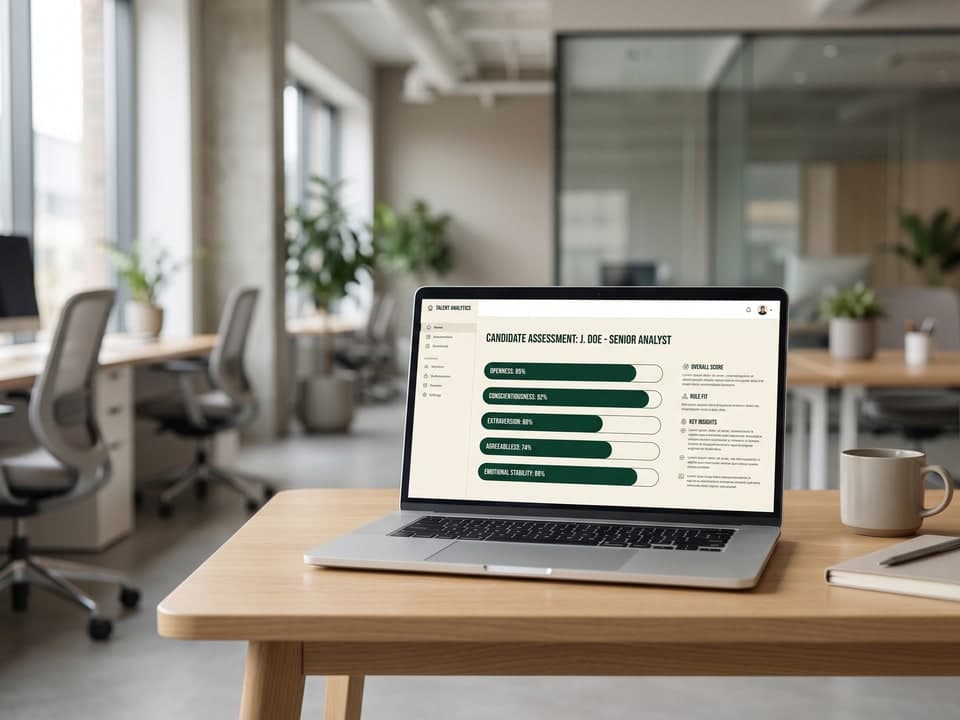
The five-factor model is the most validated taxonomy of personality in modern psychology. We administer a 100-item Likert assessment with norms across age, gender, and locale, returning percentile scores on Openness, Conscientiousness, Extraversion, Agreeableness, and Emotional Stability.
α reliability .87–.91 · external validity r = .41 for job performance
HEXACO Honesty-Humility
Ashton & Lee (2007)
HEXACO adds a sixth factor — Honesty-Humility — that materially improves the prediction of counter-productive workplace behavior and integrity-related risk. Used as an overlay on the Big Five for roles with custodial or financial exposure.
Incremental validity over FFM for CWB: ΔR² = .07
Categorical typologies
Enneagram · DISC · four-axis type indicators
Most teams already use one of the popular typologies — Enneagram, DISC, or one of the trademark-protected four-letter type indicators. We don't sell them. We map our continuous trait scores into their language inside the report so coaches and managers don't have to learn a new vocabulary.
Discussed; not deployed as a primary hiring instrument
Stress & Resilience — JDC / ERI
Karasek (1979); Siegrist (1996)
A workplace-stress instrument grounded in the Job Demand-Control model and Effort-Reward Imbalance theory. Returns a Job Strain Index, Burnout Vulnerability Coefficient, and a four-quadrant profile (active / passive / high-strain / low-strain).
Used for team diagnostics, not hiring
Cognitive style — Chronotype
Horne & Östberg (1976); Roenneberg (2003)
A short circadian-preference instrument used in shift-pattern, on-call, and follow-the-sun operations. Provided as a non-diagnostic team-fit signal alongside role design.
Operational use only
Custom competency frames
Schmidt-Hunter meta-analytic blends
We build composite scores tailored to your role architecture — e.g. a 'high-stakes IC' composite that weights conscientiousness, emotional stability, and integrity. Each composite ships with its own technical manual.
Tier 1+ engagements