ThePersonalityLab
/Frameworks

One measurement spine.
Three languages your team already speaks.

Most talent teams don't arrive with a blank slate. They already run Enneagram workshops, DISC sales training, or four-letter type indicators in L&D. We don't ask you to throw that away — and we don't pretend typologies are interchangeable with validated trait measurement.

Our approach: Big Five as the defensible core, with Enneagram and DISC as optional translation layers inside the same report. One assessment session for the candidate. One trait record for people science. Multiple readable outputs for the rest of the organization.

Full instrument catalogue →
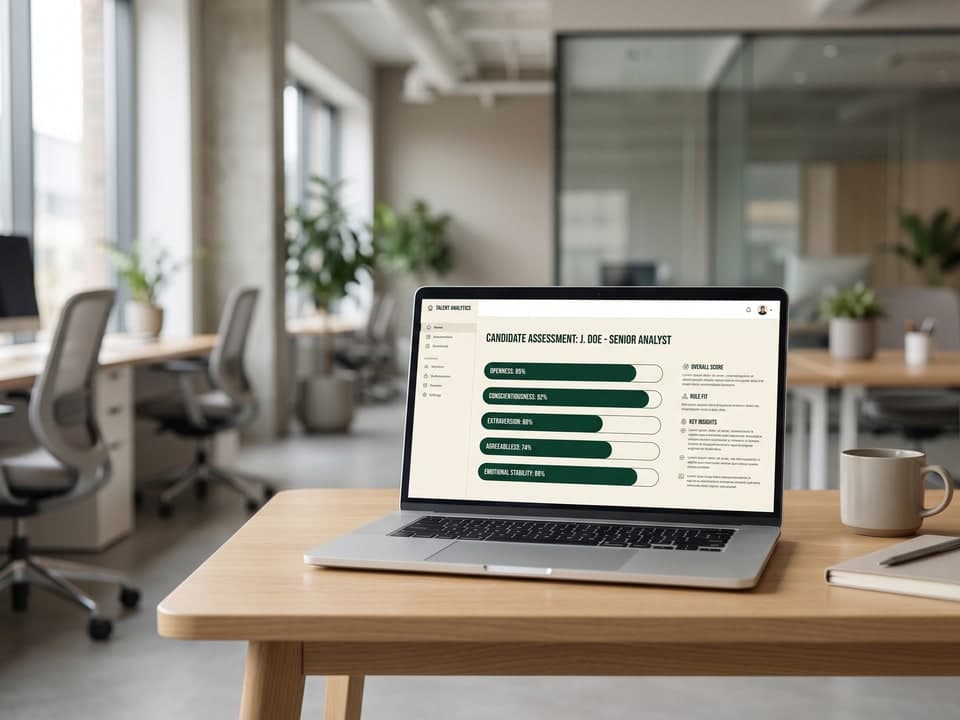
Candidate assessment dashboard on a laptop — Big Five trait report
01How we combine them
01

Measure continuously

Every assessment starts with validated Big Five (+ HEXACO overlay when the role requires integrity signal). This is the only layer used for selection, adverse-impact monitoring, and validity tracking.

02

Translate where useful

If your organization runs Enneagram workshops, DISC sales training, or four-letter type indicators internally, we add the matching translation layer to the report. Managers see familiar language; people scientists see the trait record underneath.

03

Compose for the role

Role-fit composites weight specific facets — e.g. Conscientiousness + Emotional Stability for an IC role, or Honesty-Humility + Assertiveness for a custodial finance role. Typology labels never enter the composite formula.

04

Document everything

Each layer ships with a technical manual: item structure, mapping algorithm, reliability targets, and explicit statements on what may and may not be used for hiring. Your legal and people-science teams review before go-live.

Report architecture (simplified)

Layer 1 · Big Five + HEXACOSelection · validity · adverse impact
Layer 2 · Enneagram mapLayer 2 · DISC map→ coaching · workshops · manager handoff
Layer 3 · Role composite→ weighted facet blend per requisition

Primary measurement

Big Five (OCEAN)

The spine of every assessment we ship for hiring and selection.

The five-factor model measures personality as continuous traits — not types. Openness, Conscientiousness, Extraversion, Agreeableness, and Emotional Stability (the inverse of Neuroticism) are the dimensions with the strongest published links to job performance, training success, and counter-productive behaviour when measured with validated inventories.

What a candidate actually does

100 Likert items, ~10 minutes. Statements like “I follow through on commitments even when nobody is watching.” Responses are scored on continuous scales, then converted to percentile ranks against locale-specific norms.

What the hiring manager sees

Percentile bars per trait and facet — e.g. Conscientiousness 88th percentile (Diligence + Order facets elevated). Role-fit composites when configured. No pass/fail gate; confidence intervals included.

Why it leads

Meta-analyses consistently rank conscientiousness and emotional stability among the top dispositional predictors of job performance. Continuous measurement preserves information that categorical models discard — especially for candidates near a type boundary.

Sample output fragment

Conscientiousness · 88th percentile · High band. Openness · 71st · High. Emotional Stability · 64th · Moderate. Validity coefficient for this role family: r = .46 against supervisor-rated performance (12-month lag).

Translation layer

Enneagram

Coaching and L&D vocabulary — mapped from trait scores, not administered as a hiring filter.

Enneagram layer optional · Growth tier and above

The Enneagram sorts people into nine motivational types (Reformer, Helper, Achiever, Individualist, Investigator, Loyalist, Enthusiast, Challenger, Peacemaker). It is widely used in executive coaching and team workshops. We do not use nine-type categorization as a selection criterion — but when your organization already speaks Enneagram, we translate.

How the mapping works

Big Five and HEXACO facet profiles are mapped to probable Enneagram types using published trait–type correspondence tables. The report shows a primary type, wing, and stress/security dynamics as a readable layer on top of the continuous scores.

What it is good for

Onboarding conversations, manager coaching, workshop facilitation, and internal mobility discussions where the Enneagram is already part of your culture. It gives managers a familiar shorthand without replacing the underlying measurement.

What it is not good for

Hiring decisions, promotion gates, or adverse-impact-sensitive selection. Type labels have lower test-retest stability than trait scores. The primary record always remains the Big Five percentile profile.

Example mapping

High Conscientiousness + moderate Agreeableness + elevated Achievement striving → Type 3 (Achiever) likely, with Type 1 wing. Report note: “Trait profile supports Achiever pattern; confirm in structured interview — not a selection criterion.”

Translation layer

DISC

Behavioural shorthand for sales, leadership, and team communication contexts.

DISC layer optional · Growth tier and above

DISC describes behaviour in four quadrants: Dominance (D), Influence (I), Steadiness (S), and Conscientiousness (C). It is common in sales enablement and leadership programmes. Like the Enneagram, we treat DISC as a translation layer — not a psychometric primary.

How the mapping works

Extraversion and Assertiveness facets drive D and I loadings. Agreeableness and Patience facets drive S. Conscientiousness and Order facets drive C. The report outputs a DISC profile (e.g. “DC” or “Si”) derived from the continuous Big Five profile.

What it is good for

Sales team onboarding, manager–report communication guides, and workshop materials where DISC is the internal standard. Reduces friction when talent teams need to hand results to L&D or revenue leaders.

What it is not good for

Standalone hiring decisions. DISC was designed as a communication model, not a validated selection instrument. We never score DISC in isolation without the underlying trait measurement.

Example mapping

High Extraversion + high Assertiveness + moderate Agreeableness → “Di” profile (Dominance-Influence). Paired interview prompts: “Describe a time you had to push back on a stakeholder without damaging the relationship.”

/ See it on a real role

We'll walk through a sample report for your requisition.

Tell us the role, the frameworks your team already uses, and the evidence standard you need to defend. We'll send a redacted sample report and the mapping manual before the first call.